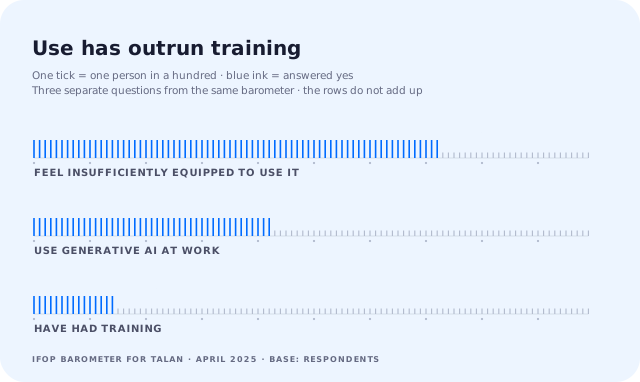
Your teams are already using generative AI. The Ifop barometer for Talan, published in April 2025, found that 43% of respondents say they use generative AI at work. At the same time, only 15% had taken any training. The rest are teaching themselves, with no framework, often without telling anyone. Your company pays twice: once for tools used poorly, and again for the mistakes they produce. Generative AI training fixes this problem - provided you know what it should contain.
Key Takeaways
- 15% of employees have received generative AI training, while 73% feel they lack sufficient knowledge to use it correctly (Ifop/Talan, 2025)
- A serious program covers six areas: how it works, prompts, job-specific uses, verification, confidentiality, and a real project
- 44% of employees teach themselves AI (Saegus/Odoxa, 2025): without a framework, usage spreads unchecked and sensitive data travels with it
- A half-day demo trains no one; the right format runs to days, working with your actual data
Why generative AI training has become a leadership issue
Adoption is moving faster than skills. Insee, France's national statistics institute, counted 10% of French companies with 10 or more employees using at least one AI technology in 2024, up from 6% a year earlier. Among small and mid-sized businesses, Bpifrance Le Lab measured that 31% used generative AI by late 2024, double the 2023 figure. Business leaders, for their part, have grasped the stakes: 58% of SME and mid-cap leaders see AI as a matter of company survival, according to Bpifrance Le Lab.
The gap between usage and mastery shows up in the training figures. The Ifop/Talan 2025 barometer reports that 43% of respondents use generative AI at work, but only 15% are trained. In the same study, 73% of French respondents feel they lack sufficient knowledge to use these technologies effectively. The Saegus firm, in partnership with Odoxa, found in September 2025 that 44% of French employees teach themselves AI.
The result is called shadow AI. Still according to the Ifop/Talan study, 37% of employees who use AI at work don't tell their manager. The outcome: customer data copied into public tools, content published without review, and a company that discovers the practice after the fact. Structured training is the first line of defense against these practices. It's also a matter of scale: OPIIEC, the observatory for the digital, engineering, consulting, and events sectors, estimated in June 2025 that nearly 287,000 employees will need to be trained or made aware of AI by 2030 in these sectors alone.
The six building blocks of a program that changes something
A good generative AI training program isn't just a list of tools. Tools change every quarter; skills don't. Here are the six building blocks a serious program must cover, whatever your teams' jobs.
Understanding what the tool does
Before learning to use it, you need to know what you're dealing with. Generative AI produces text, code, or images from your instructions. It doesn't think, it doesn't check anything, and it doesn't know your company. It calculates likely sequences of words. This distinction prevents two opposite mistakes: believing the machine is right because it sounds fluent, and believing it's useless because it sometimes gets things wrong.
The program should also introduce the families of tools: general-purpose assistants, tools specialized by profession, and solutions hosted in Europe or run locally. Where a tool is hosted has direct legal consequences, and deserves a real explanation, not a passing mention.
Structuring a request
The prompt is the instruction you give the tool. Most users write a vague sentence and then wonder at the result. Useful training teaches a method: specifying the expected role, the context, the output format, the constraints. It shows how to ask a series of questions rather than hoping for a perfect answer on the first try. It also provides reusable templates by profession: one frame for a sales proposal, another for meeting minutes, another for a customer reply.
This is the most valuable building block in the whole program. It turns a tool that's fun to play with into one that actually produces.
Your job's use cases
Bpifrance Le Lab found that 68% of business leaders using generative AI use it to write text. Writing dominates, but it's only one entry point. A good program starts from your teams' real tasks and shows, for each one, whether AI helps, how, and where it's no use at all.
A few examples worth reviewing depending on your business: summarizing long documents, preparing responses to tenders, writing product sheets, structuring meeting minutes, qualifying incoming requests, drafting quote proposals. The rule is simple: automate a repetitive task with a checkable output, not a decision that commits the company.
Checking what the machine produces
Generative AI makes things up. It blends sources, produces plausible-looking numbers, and cites studies that don't exist. That's a feature of how it's built, not a bug. Training must therefore teach critical review: checking figures, tracing them back to sources, demanding references, and having a human review sensitive content.
This skill is called judgment, and you don't acquire it by watching a demo. You acquire it by practicing on real documents, with a trainer who shows where the tool gets things wrong. If your program skips this building block, it's training people to publish mistakes faster.
Confidentiality and the legal framework
This is the building block that separates responsible training from a gimmick. The GDPR governs the processing of personal data, including when it passes through an AI tool. Pasting a customer file into a public assistant can amount to sending personal data outside any framework. The European AI Act adds obligations for certain uses. Teams need to know what they can enter, and what they must never enter.
Two simple rules to pass on: anything confidential doesn't go into a public tool, and choosing a tool hosted in Europe or installed locally changes the equation. This is exactly the position we hold at NexeAI: local, no-code AI keeps data inside the company.
A real project
The sixth building block isn't a lesson, it's a condition. Training that doesn't lead to a concrete project is forgotten within three weeks. From the start, the program should plan for each participant to bring a real task from their work and handle it during the training. By the end, the team leaves with one or two improved processes, not a certificate.
That's what separates training from awareness-raising. Awareness-raising creates the desire; training creates the habit.
What training should not be
The AI training market has filled up in two years, and not everything is worth the same. Here are the signs of a weak program.
A half-day tool demo, with a trainer running through examples without any hands-on practice, trains no one. A program that mentions neither confidentiality nor the tools' limits is incomplete. A program with no exercise on your real data doesn't prepare you for your reality. A program that promises to "make everyone an expert in a day" is lying, and knows it.
Also be wary of training that confuses generative AI with data science. An introductory generative AI program doesn't need Python, machine learning, or statistics. It needs practice, method, and use cases. If the program looks like a programming course, it's aimed at a different audience than your business teams.
General or specialized: how to decide
Once the foundation is in place, the question becomes: continue with general training or specialize? It all depends on the use you're aiming for.
General training fits when the need is broad: everyone writes, summarizes, searches. Specialized training fits when a specific role wants to automate repetitive tasks: document processing, request qualification, preparing replies. If you want your teams to build automations without writing code, no-code training is the logical next step. If you're aiming for AI agents that work on your behalf across entire processes, the topic deserves a dedicated program.
Our advice: start with the foundation for everyone, then specialize the teams whose tasks are the most repetitive. That order produces visible results the fastest.
FAQ
Is a one-day course enough?
A day is enough to lay the foundation: how it works, prompts, use cases, confidentiality rules. That's the minimum format for serious awareness-raising. To make the habit stick and handle a real project, plan for two to five days, spread out or not, with follow-up between sessions. The right length depends less on the starting level than on the depth you're aiming for.
Should you train everyone, or only a few teams?
Both, at different levels. Everyone needs the foundation, because everyone handles data and can be tempted by a public assistant. Teams with repetitive tasks (writing, data entry, document processing) need to go further. The cost of an untrained employee pasting customer data into a public tool far outweighs the cost of training them.
What about employees who already use AI on the sly?
Don't punish them, guide them. Spontaneous use is a signal: your teams have found a way to save time. Training turns that signal into controlled practice. The goal is to bring the practice out into the open: clear rules, approved tools, room for error on non-sensitive content. As a reminder, 44% of employees teach themselves - it's a mass phenomenon, not an individual failing.
Should training cover AI agents?
If you're planning to automate entire processes, yes. AI agents go further than an assistant that answers questions: they carry out a sequence of steps, consult your tools, and deliver a result. An introductory program can mention them; training aimed at automation should devote a real module to them. It's a fast-growing topic, and it's our specialty at NexeAI.
Conclusion
Generative AI use has exploded, training has lagged far behind, and employees are figuring it out on their own. Well-built training fixes the problem: it installs method, sets confidentiality rules, and produces concrete results on your tasks. Remember the order of priorities: the foundation for everyone, specialization for those automating processes, and never a program without hands-on practice or a legal framework.
If you want to set up custom training for your teams, let's talk. We always start with an assessment of your needs before building the program, and we train on your real cases rather than generic exercises. To go further, read our guide to AI training in business, discover what we write about generative AI in business, or compare the free training options available. And if automation interests you, our training page presents our full range of programs.